I want to explain an idea to you, it might be a simulation, but more likely it's a simulacrum, let me explain.
If I describe an object to you, green and red, spherical in nature, you might deduce I am talking about an apple but it could have been a juggling ball. I am trying to simulate the object to you using words, if you understood it to be an apple then my description simulated the reality closely enough to be a fair representation of it. If instead you thought I was talking about a juggling ball, then my description was a simulacrum, an attempt to simulate something which in turn fails.
Right now I'm trying to explain the idea of simulation vs simulacrum to you, this was an idea I recently came across from the YouTube channel @FractalPhilosophy, but he himself is simulating the ideas from a book Simulacra and Simulation by the French philosopher Jean Baudrillard. Now I have no idea if he is accurately representing that idea or not as I have not read the original text. Is he simulating the complex ideas within, or is his representation a complex simulacrum, so far removed from the original meaning that it no longer accurately represents it.
Ok that's pretty meta, but we do this all the time. Our mental models of how the world work are simulations, or if they don't represent the detail well enough they are simulacrums. Take something like GDP, Gross domestic product. It is a time worn and worn out way of boiling down an entire countries economic activity into a single number. If that sounds impossible, idiotic and dumb, you would be correct on all counts, and yet economists still utilise this number with abandon (and governmental economists doubly so).
So we've simplified a complex idea into a simple understandable one, and in doing so created a simulation so removed from the reality, that it is now a simulacrum. But what happens, when the simulacrum starts altering reality and distorting the simulations...
Ok, hang in there, I promise this will all make sense.
Seeing Like a State is a book by James C. Scott, where he explores how states use simplified accounting systems (simulacrum) in an attempt to optimise the world around them. Attempt being the operative word.
Scientific forestry was originally developed from about 1765 to 1800, largely in Prussia and Saxony. - Seeing Like a State: James C. Scott
If I am the King in the 1800's, and my advisors tell me that using this new 'scientific' methodology we could double the yield of our forests, meaning my subjects would have more firewood, my shipwrights would be able to build more ships and my navy would be stronger for it. Well who am I to argue against science.
Enter the age of fiscal forestry. My background is chemistry, taking the chaotic world, understanding it and improving it, that is my bread and butter. So if you tasked me with improving the output of the forest to help our great nation, you better believe I'm going to make all the same mistakes that they made back then.
You know, I'm something of a scientist myself - Norman Osborn
Start with a simulacrum, some measure for us to simplify this complex chaotic system otherwise known as nature. It could be tree's per acre, or perhaps kilograms of wood cut down per year, perhaps it's units sold or better yet lets talk money. The total value derived by selling trees per acre / cost of your forestry operations.
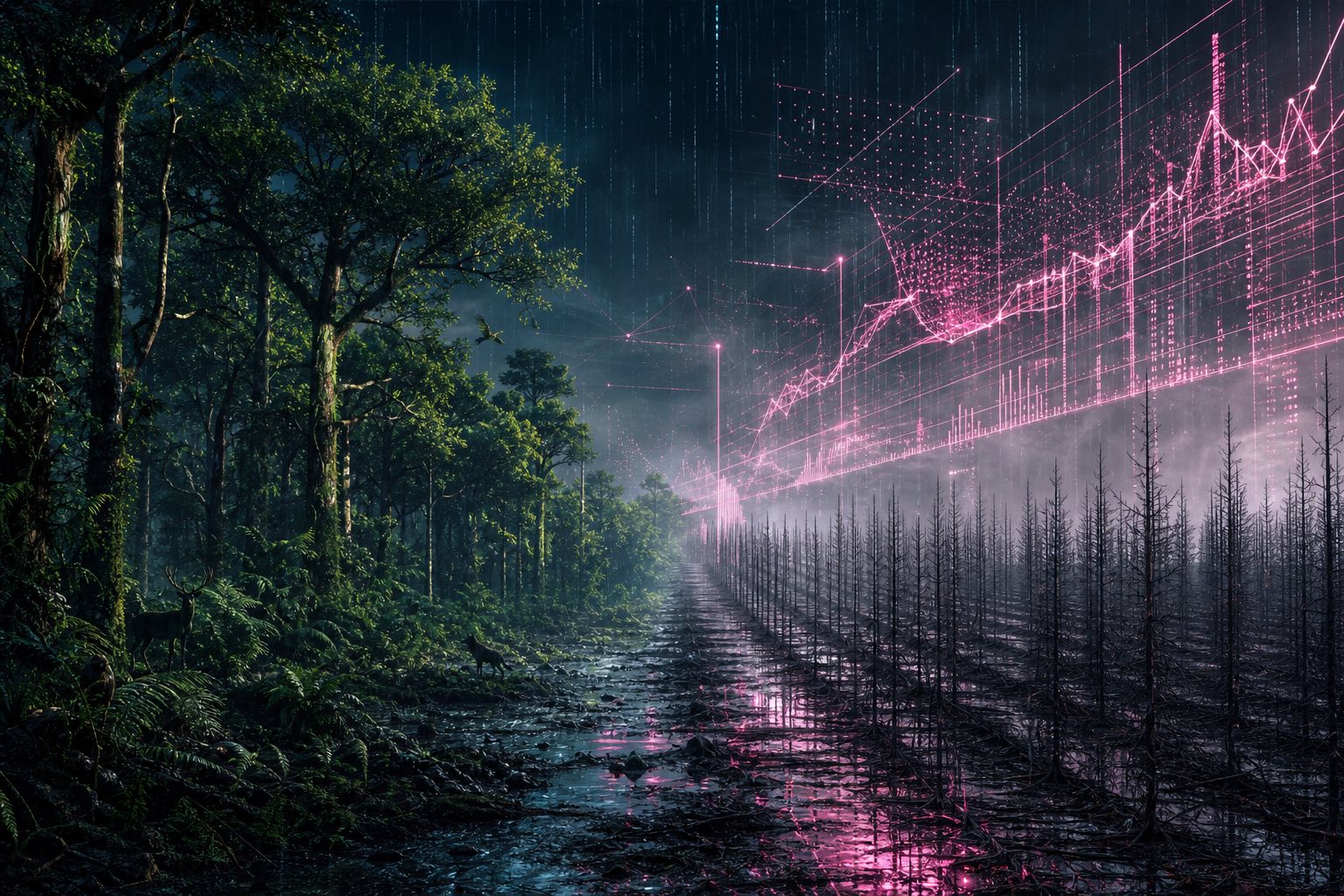
Now organise your entire forest, plant forests in neat little rows, get rid of that biodiversity and grow just the most profitable type of tree. Cut away the brush,the dead leaves, the fallen trunks and profit.
Thats exactly what they did, they planted the Norway spruce, a hardy rapid growing tree of high value and for a time it was good. The trees were felled, the wood consumed and everyone patted themselves on their backs.
Shareholder value had been increased, after all the simulacrum says it so it must be true, that little simulacrum had inspired humans to reorder the forest to its whims, simulacrum alters reality. Ignore the value not measured by it, the species killed and evicted from their homes, the food sources for animals and humans alike. The variety of plants serving varied uses by the communities that lived in the area. The line must go up and so it did.
And then a hundred years later the real impact started to become apparent. After the first generation of trees grown in this manner were felled, the next generation would be the ones to grow in the simulacrums soil.
The reasons are complicated, but the word Waldsterben (forest death) would enter the German vocabulary to account for the impact of systematically destroying the ecology of the forest. From eroding the nutrient rich soil, interrupting the complex interactions between bacteria, fauna and animals and all the other processes required to keep a forest healthy. Then sustain such damaging practices for over a hundred years.
So a hundred years of profit for centralised authority (share holders), at the cost of individuals, nature and diversity, driven by a simulacrum, an all consuming set of figures and numbers all to drive another simulacrum money. If this doesn't give you a slightly bitter taste of todays world, then please provide me with your brand of mouthwash.
I'm sorry dear reader, I have to bring up the AI simulacrum in the room. Today there are businesses in the world in the process of attempting to bring order and efficiency to the chaotic, messy world of the job market (At least thats what they say).
Want some artwork for your advertising, we have a simulacrum of an artist just for you. Note it's a simulacrum not a simulation, it can not simulate the nuance and context that an artist brings to their work. An AI might create an image for you, but an amazing artist will take your prompt and layer on social and personal experience, combined with their talent to create something unique. Our simulacrum will spit out what ever amalgamation of it's stolen training data gave it the best reinforcement during its training.
Today AI companies preach that they will be the ones to convert todays simulacrums into simulations. That they will work for a fraction of the cost, without pause or complaint. Removing the pesky workers, who dare to ask for pay and time off from the corporate ecosystem.
What these companies don't seem to understand is they are attempting to fell a forest and plant neat little trees in its place. From the outside it looks beautiful and ordered, but the value of a company isn't in its simplicity, its in the complex connections with high levels of diversity. Combine a highly organised OCD individual with a carefree artistic soul, sprinkle in a socially awkward engineer and a sales person with the gift of the gab, that diversity is what drives innovation and value in a way that an AI simulacrum couldn't even consider competing with.
But what if we don't realise this for a hundred years or even twenty. How many years do we have to strip the soil of its nutrients before we have to add a word to our vocabulary. Not Waldsterben, not forest death, but company death. If we don't train the next generation of employees and pass down our experience and knowledge down. If we don't keep our society healthy with diverse skill sets, what then.
The share holders may make their profits in the short term, but who will be paying the cost of those returns when the forest dies?
And the irony of using AI generated cover art for this blog is not lost on me...